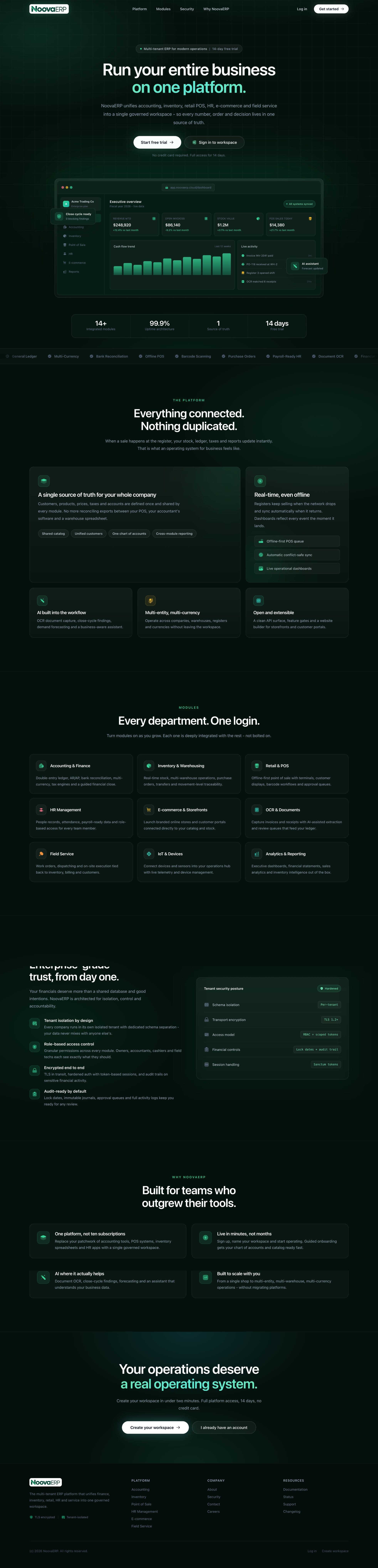
NoovaERP — Multi-Tenant Enterprise ERP SaaS Platform
Modular multi-tenant ERP with double-entry accounting, inventory, invoicing, and Malaysia/Singapore accounting compliance modules.
Type
Tech stack
Documentation
Full
Setup, architecture, and how the pieces fit together.
Maintenance
Occasional
Occasional fixes, but no active roadmap.
Description
NoovaERP — Multi-Tenant SaaS ERP Platform
NoovaERP is an API-first Enterprise Resource Planning platform designed to support multiple businesses through a shared SaaS infrastructure with tenant-level database schema isolation.
Built with Laravel 11, React, TypeScript, PostgreSQL, and Python, the platform combines core business management functionality with a centralized accounting engine, a disk-driven module system, a dedicated platform administration console, and a standalone OCR microservice.
The architecture is designed for developers and software businesses looking to extend, customize, or commercialize an ERP platform without starting from scratch.
Key Features
Multi-Tenant SaaS Architecture
- Tenant signup, onboarding, provisioning, and subdomain routing.
- PostgreSQL schema-per-tenant isolation using
stancl/tenancy. - Central tenant metadata and subscription information.
- Token-based API authentication using Laravel Sanctum.
- Role-based access control integrating Spatie Permission.
Centralized Double-Entry Accounting
- Chart of accounts and opening balances.
- Journal entries and journal entry lines.
- Centralized posting through a shared
PostingEngine. - Invoice posting with accounts receivable, revenue, and tax entries.
- Payment posting with cash and accounts receivable entries.
- Trial balance and account ledger endpoints.
- Accounting workflows designed around balanced debit and credit entries.
Sales, Invoicing, and Inventory
- Product catalog with SKU, pricing, cost, and stock tracking.
- Customer records and outstanding balance management.
- Invoice creation with line items, totals, and PDF generation.
- Payment recording and invoice balance updates.
- Inventory stock movements linked to sales workflows.
- Dashboard KPIs, revenue charts, and recent activity.
Modular ERP Framework
Business capabilities are organized into modules with their own routes, controllers, services, models, and module contracts.
The repository documents modules and capabilities spanning sales, purchasing, HRM, CRM, POS, event management, IoT, website building, and financial close. The module registry supports disk-driven discovery and activation through module metadata.
The completeness of individual modules varies and should be verified during technical evaluation.
Malaysia and Singapore Accounting Modules
NoovaERP includes a country-specific accounting module structure under backend/modules/AccountingCountry/, with separate modules organized around shared submission and mapping contracts.
The project identifies statutory accounting and e-invoicing as target workflows for Malaysia and Singapore. Buyers should verify the specific implemented integrations, regulatory coverage, submission flows, and current compliance requirements before relying on these modules in production.
OCR and Bookkeeping Integration
A standalone Python OCR microservice is designed to integrate with the backend's document-processing and bookkeeping ingestion workflow.
This architecture provides a foundation for extending document-based data extraction and accounting automation.
Dedicated SuperAdmin Console
A separate React and Vite application provides the platform-operator interface for tenant provisioning, subscription entitlements, and the module catalog.
This is distinct from the tenant-facing ERP application.
Technology Stack
Backend: Laravel 11, PHP, PostgreSQL, Redis, Laravel Sanctum, Spatie Permission, and stancl/tenancy.
Frontend: React 18, TypeScript, Vite, Tailwind CSS, shadcn/ui, Zustand, React Query, and React Router.
Supporting Services: Python OCR microservice, Docker Compose, and GitHub Actions CI workflows.
Developer Experience and Testing
The repository includes Docker-based development instructions, service-specific setup guides, API documentation, database schema descriptions, example accounting workflows, tenant provisioning checks, and CI workflows for backend provisioning and frontend type/lint regression checks.
The documented development setup includes PostgreSQL, Redis, the Laravel API, the tenant frontend, and the OCR service.
Potential Commercial Applications
NoovaERP can serve as a foundation for:
- Launching a branded ERP SaaS product.
- Developing industry-specific ERP solutions.
- Extending accounting, inventory, invoicing, and purchasing workflows.
- Building multi-tenant business management applications.
- Integrating ERP functionality into external applications through REST APIs.
- Developing regional accounting and e-invoicing solutions, subject to regulatory validation.
Architecture and Extensibility
The API-first approach separates backend business logic from the tenant-facing frontend and platform administration console. The modular structure is intended to support additional business capabilities, integrations, and future product extensions.
Development Roadmap
The documented roadmap includes advanced procure
FAQ
- What accounts or services do I need to set up before running this?
- You need PostgreSQL and Redis running. The platform is designed to run in Docker, so Docker and Docker Compose are required. If you want to use the OCR microservice, you'll need Python set up as well. No third-party SaaS accounts (payment processors, auth services, email) are baked in, those integrations are yours to add.
- What's the actual tech stack?
- Backend is Laravel 11 with PHP, PostgreSQL, and Redis. Frontend is React 18 with TypeScript, Vite, and Tailwind. There's a separate Python OCR microservice. The codebase uses `stancl/tenancy` for multi-tenant schema isolation and Spatie Permission for role-based access control.
- How complete are the Malaysia and Singapore accounting modules?
- The project identifies statutory accounting and e-invoicing as target workflows for these regions, but the completeness of individual modules varies. You'll need to verify which specific integrations, regulatory coverage, and submission flows are actually implemented before using this in production.
- What documentation and testing is included?
- Documentation is basic. You get Docker setup guides, API documentation, database schema descriptions, and example accounting workflows. The repository includes CI workflows and tenant provisioning checks. Test coverage is not documented.
- What level of maintenance should I expect?
- This is a no-maintenance listing. You own the codebase outright and are responsible for all updates, bug fixes, and ongoing support.
Domains
Seller

Reviews
No reviews yet.
Related reading
A breakdown of what an online store for the Egyptian market actually needs, and where starting from a finished build saves you a quarter.